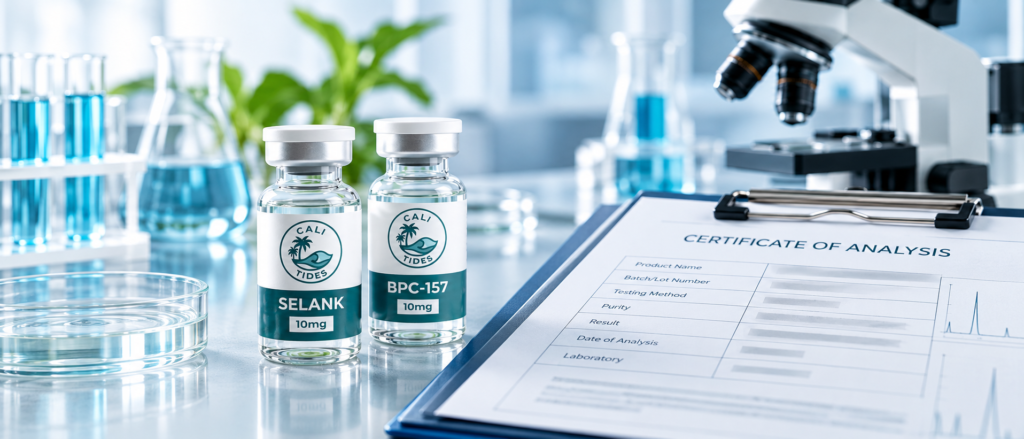
When evaluating research products, you’ll often see terms such as “lab tested,” “third-party tested,” or “COA available.”
But what do these terms actually tell you?
Testing can provide useful information about a product’s characteristics, but understanding who performed the testing, what was tested, and how the results are documented is just as important as seeing a testing claim on a product page.
Here’s why third-party testing can be an important part of evaluating research products.
What Is Third-Party Testing?
Third-party testing means the testing is performed by an independent laboratory rather than solely by the company selling the product.
The basic idea is straightforward:
Supplier → Independent Laboratory → Test Results
Instead of relying exclusively on the supplier’s own internal assessment, an outside laboratory performs the analysis. This can provide an additional layer of transparency when evaluating research materials.
Why Does Independent Testing Matter?
Consider two suppliers selling products with similar descriptions.
Supplier A says:
“Our products are high quality.”
Supplier B provides laboratory documentation showing testing results associated with a specific batch.
The second supplier is giving you something more useful to evaluate.
You’re no longer relying entirely on a marketing statement. You have documentation that provides additional information about the material that was tested.
That doesn’t mean a third-party test automatically guarantees everything about a product.
It means the testing provides additional evidence that can be reviewed.
What Can Testing Tell You?
The answer depends on the specific test performed.
Laboratory testing can be used to evaluate different characteristics of a material, including things such as:
● Identity
● Purity
● Strength or concentration
● Composition
● Certain impurities or contaminants
The specific information available depends on the testing method and the laboratory’s scope.
That’s why it’s important not to treat every COA or laboratory report as if it contains the same information.
The Key Question
What exactly was tested?
Don’t Just Look at the Purity Number
A common mistake is to look at a COA, find a large purity percentage, and stop there.
But a testing document contains more information than one number.
Product or Material
Does the document clearly identify what was tested?
Batch or Lot
Can you determine which batch the results apply to?
Testing Method
Does the document identify the method used for the analysis?
Results
What were the actual reported results?
Laboratory
Who performed the testing?
Date
When was the testing performed?
These details provide context around the reported result.
Why Batch-Specific Documentation Matters
Imagine a supplier tests one batch and publishes the results.
Later, another batch is produced.
Can you assume the second batch has exactly the same characteristics?
Not necessarily.
That’s why batch identification is useful.
A batch-specific document allows you to connect the testing information to a particular production lot.
For research purposes, this creates a clearer chain of documentation:
Specific Product
↓
Specific Batch
↓
Laboratory Testing
↓
Reported Results
This is much more informative than simply placing a generic “99%+ purity” statement on a product page.
Third-Party Testing Isn’t a Magic Guarantee
It’s also important to keep expectations realistic.
Third-party testing doesn’t mean:
● Every possible characteristic has been tested
● Every possible contaminant has been ruled out
● The product is automatically appropriate for every research application
● A laboratory result guarantees future batches will be identical
Testing tells you about what was tested, how it was tested, and what the laboratory reported.
That’s why good documentation matters alongside testing itself.
What Should You Look For?
When evaluating a supplier, look beyond the words “third-party tested.”
Ask:
Is Testing Documentation Available?
Can you actually review the results?
Is the Batch Identified?
Can you connect the report to the product you’re considering?
Is the Testing Method Identified?
Does the documentation explain how the analysis was performed?
Is the Laboratory Identified?
Can you determine who performed the testing?
Are the Results Clearly Reported?
Can you understand what the laboratory found?
These questions give you a much better basis for evaluating a supplier than a marketing claim alone.
Transparency Makes Testing More Useful
Testing is most useful when customers can actually review the information behind the claim.
That’s why transparency matters.
A supplier that provides accessible product information, testing documentation, manufacturing information, and relevant quality documentation gives researchers more information to evaluate before placing an order.
At Cali Tides, our approach is centered around providing clear product information, USA manufacturing, testing, and available COAs.
Explore Cali Tides Products
Looking for research products backed by accessible quality information?
Explore Cali Tides products and review the available product information and documentation.